Descent: Surface to Twilight
Close your eyes for a second, or don't.
Picture the surface. Light breaking apart into blue. The sound of the world above already fading.
You're going under.
Descent: Twilight to Abyssal
Down here, sound moves differently. Farther. Slower. Truer.
A whale is calling to another whale hundreds of miles away, and the water carries it there whole.
Something clicks, sharp and quick, then goes quiet. A current shifts, and the whole reef seems to lean with it.
You are not the loudest thing in this water. You are not even close.
The light is nearly gone now. What's left comes from the water itself.
The Turn: Abyssal Floor
Almost none of this has ever been seen.
Less than 0.001 percent of the deep ocean floor has been visually observed by anyone, ever. An area smaller than Rhode Island, in a space that covers most of the planet.
We have mapped less than a third of our own seafloor at any real resolution. We have not finished mapping the planet we live on.
This is not a knowledge gap. It is a blind spot, at the scale of a planet.
Atlantis Pads puts people and instruments in the water that isn't being watched. Research residencies. ROV operations. Data, where there was only guessing.
Ascent 1: Abyssal to Deep
The fish stocks that once fed whole coastlines are collapsing, quietly, one closed season at a time.
Warming water is moving faster than the species that depend on staying cold.
None of this waits for a five-year plan.
Atlantis Pads grows what the ocean can still carry. Seaweed, shellfish, species suited to the water as it actually is now, not as it used to be.
Ascent 2: Deep to Mid
The reefs that took thousands of years to build are dying in decades.
Coral reefs cover a fraction of a percent of the ocean floor and hold up a quarter of all marine life. When they go, they don't go quietly, and they don't come back on their own.
Atlantis Pads restores what's collapsing, actively, in the water, not from a lab.
Okinawa: Arrival
Before dawn, the dock at Onna is already working.
A mozuku line is checked by hand, the way it has been checked for generations. The man doing it has done this since before some of the machines that could replace him existed. He does it anyway, because no machine does it right yet.
A few hundred meters up the coast, an OIST researcher logs coral data before the water gets too bright to read it clearly.
This coral keeps this seaweed alive. This seaweed feeds most of Japan. Neither fact is abstract here. They are the same tide.
The reef is under stress. The people who know this water best are aging out faster than anyone is training to replace them.
This is not a place asking for sympathy. It is a place that still works, that still produces, that is running out of time to pass on what it knows.
Okinawa: Discover the Site
Five places worth a closer look. None of them are required.
With partnership, this is what Onna could become: the cooperative fully resourced, the coral monitoring funded before the reef needs saving instead of after, the knowledge that took a lifetime to earn actually passed to someone young enough to carry it another fifty years.
None of that is guaranteed yet. All of it is buildable.
This is a place that needs someone to grow alongside it.
Now, here is what happens when protection comes early instead of too late: the largest network of marine protected areas in the North Atlantic, built with the people who live on this water, not around them.
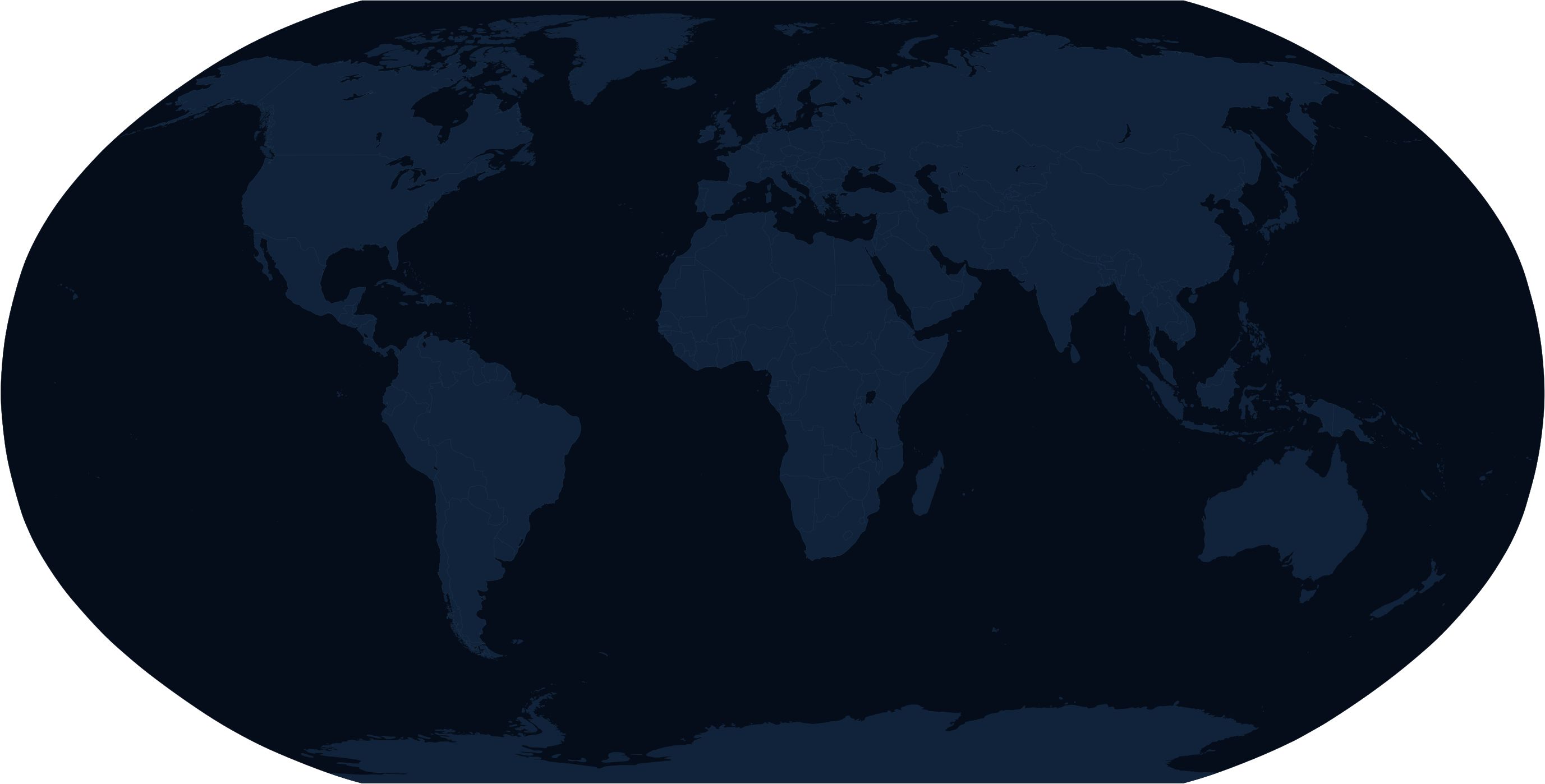
Traveling to Azores, Portugal
Azores: Arrival
5am, and the whale-watch boats are already leaving Horta in the dark.
Pico is lit up against a sky that hasn't decided yet if it's night or morning. An OKEANOS researcher is on the dock before the first boat clears the breakwater.
The channel is a mirror. The cetaceans come daily, on schedule, as if they know something the rest of the world hasn't caught up to yet.
This is not a place proving it can survive. It's a place proving the whole idea works, without asking for anything extra to make the math close.
Azores: Discover the Site
Four places worth a closer look. None of them are required.
Okinawa is what happens when protection comes late.
Azores is what happens when it comes early.
Same ocean. Same kind of place. Different timing, different outcome.
This is not luck. It is not geography. It is a choice, made in time or made too late, and the numbers follow the choice.
Every site in this network gets measured against the same question: has this water been protected, or does it still need to be?
The Wider Network